Modernized Basic Control Skills Test Overview

Jason Boudreau • March 10, 2025

The Basic Control Skills Test is a crucial part of obtaining your Commercial Driver’s License (CDL). It evaluates your ability to maneuver a commercial vehicle safely and accurately, testing skills essential for real-world driving scenarios.


In this article, we’ve compiled a series of stop-motion videos that break down each part of the BCS test—Forward Stop, Straight Line Backing, Forward Offset, and Reverse Offset—into simple, easy-to-follow steps. Alongside the videos, you’ll find detailed descriptions and practical tips to help you navigate each exercise with confidence.

Estos videos también están convertidos al español haga clic aquí para ver la traducción

View the CDL Manual's Modernized Supplement

Understanding the Test Structure

The Basic Control Skills Test is divided into four main exercises designed to assess your ability to control your vehicle in tight spaces and to judge its position relative to other objects. You must pass this test before moving on to the Road Test.

Components of the BCS Test:

  1. Forward Stop
  2. Straight-Line Backing
  3. Forward Offset Tracking
  4. Reverse Offset Backing

Each exercise tests specific skills and requires precision and control.


Scoring Criteria for the Basic Control Skills Test

The Basic Control Skills Test evaluates your ability to maneuver a commercial vehicle safely and accurately. The test consists of four exercises, each with specific scoring criteria based on performance in various areas. Points are deducted for pull-ups, encroachments, looks, and improper final positioning. Below is a detailed breakdown of the scoring criteria as outlined in the CDL Handbook.

Pull-ups

Definition:
A pull-up is when you move the vehicle forward during a backing exercise to adjust your position and avoid encroachments.

Scoring:

  • Allowed Pull-ups:
  • Exercise 2 (Straight-Line Backing): 1 free pull-up allowed.
  • Exercise 4 (Reverse Offset Backing): 2 free pull-ups allowed.
  • Penalties:
  • Excessive pull-ups beyond the allowed free pull-ups result in point deductions.
  • Stopping without changing direction is not counted as a pull-up.


Back-ups

Definition:
A back-up occurs when you move the vehicle backward during a forward-moving exercise to reposition yourself.

Scoring:

  • Applicable Exercise:
  • Exercise 3 (Forward Offset Tracking).
  • Penalties:
  • Each back-up during this exercise results in point deductions.
  • No free back-ups are permitted.


Encroachments

Definition:
Encroachments occur when any part of your vehicle (except mirrors or high-mounted unique parts) crosses or touches the exercise boundary lines or cones.

Scoring:

  • Penalties:
  • Each instance of touching or crossing a boundary line results in point deductions.
  • Unique parts above door mirror height (like a bucket truck) do not count as encroachments unless they are below mirror height.


Looks

Definition:
A “look” is when you exit the vehicle to check its position during a backing exercise.

Scoring:

  • Allowed Looks:
  • Exercise 2 (Straight-Line Backing): 1 free look allowed.
  • Exercise 4 (Reverse Offset Backing): 2 free looks allowed.
  • Penalties:
  • Exceeding the allowed looks results in point deductions.
  • Opening the door or moving from a seated position to look outside is also counted as a look.
  • Opening the door while the vehicle is in motion may result in automatic failure.


Final Position

Definition:
Final position evaluates how well you align your vehicle within the designated boundaries at the end of each exercise.

Scoring:

  • Penalties:
  • Points are deducted if your vehicle does not finish within the boundaries or as instructed by the examiner.
  • The vehicle must be straight and fully within the defined area.


Automatic Failures

Certain actions can lead to immediate failure of the test, regardless of the score.

Automatic Failure Criteria:

  • Failure to Follow Instructions:
  • Not complying with the examiner’s directions.
  • Unsafe Acts:
  • Examples include forgetting to set the parking brake, opening the door while in motion, or not maintaining three points of contact when exiting or entering the vehicle.
  • Any action deemed unsafe by the examiner.

Layout of the Modernized Basic Control Skills Test:
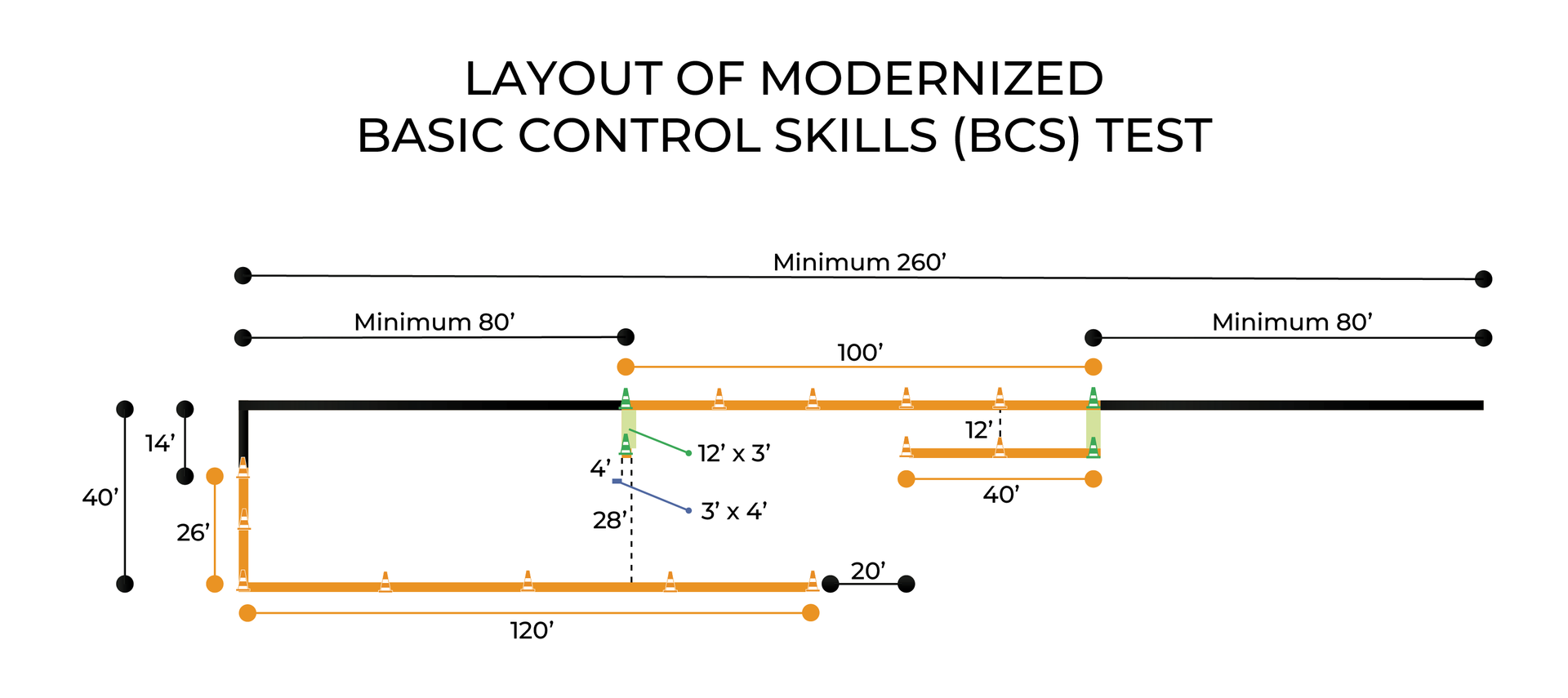
A diagram of a layout of modernized basic control skills test

Forward Stop:

Modernized Basic Control Skills Test Exercise 1


Objective:

To assess your ability to judge the front end of your vehicle during a controlled stop.


  • Starting Position: Begin before the first set of cones at the alley entrance.

  • Pulling Forward: Move forward carefully and aim to place the frontmost part of your vehicle inside the stop box. You may stop only once.

  • Completing the Maneuver: Once in the stop box:
  • Set the parking brake
  • Shift to neutral
  • Sound your horn to signal to the examiner that you’re finished. 
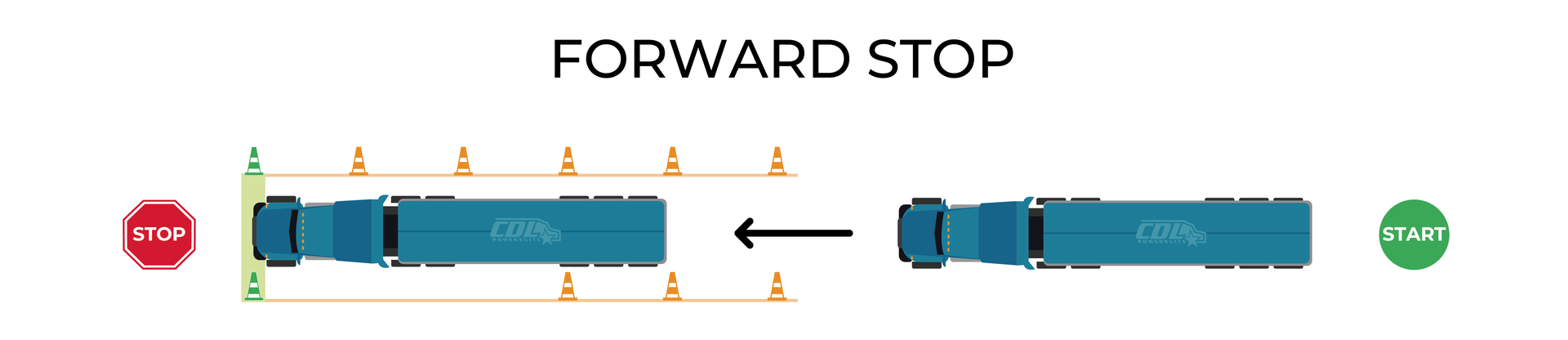
A diagram of a forward stop with a red stop sign and a green stop sign.

Straight Line Backing:

Modernized Basic Control Skills Test Exercise 2

Objective:

To evaluate your ability to reverse your vehicle in a straight line.

  • Getting into Position:  After completing the forward-stop exercise, pull forward until your vehicle is outside the coned area at the end of the alley.

  • Backing Up:  Carefully back through the 100-foot alley:
  • You’re allowed one get-out-and-look to check your position.
  • You may also use one free pull-up if needed. Additional pull-ups will result in penalty points.

  • Completing the Maneuver:  Once you’ve backed through the alley:
  • Set the parking brake
  • Shift to neutral
  • Sound your horn to signal the examiner that you’re done.
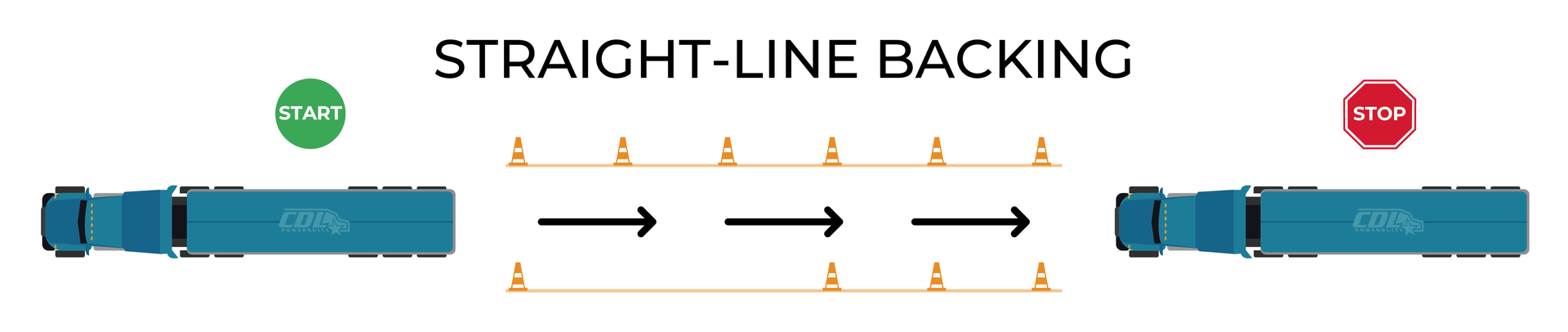

A diagram of a straight line backing between two trucks.

Forward Offset Tracking:

Modernized Basic Control Skills Test Exercise 3

Objective:
To test your ability to maneuver around obstacles while moving forward.


  • Starting Position: Begin behind the cones at the alley entrance.

  • Executing the Maneuver: Pull forward through the alley and steer to the left opening of the opposite lane:
  • Keep the near-most axle of your vehicle within the two-foot mark that is four feet from the frontmost cone as you exit.
  • Important: You cannot back up the vehicle without receiving penalty points. You may not exit the vehicle. 

  • Completing the Maneuver: Position your vehicle parallel with the outer boundary cones. Then:
  • Set the parking brake
  • Shift to neutral
  • Sound your horn to signal the examiner that you’re done.
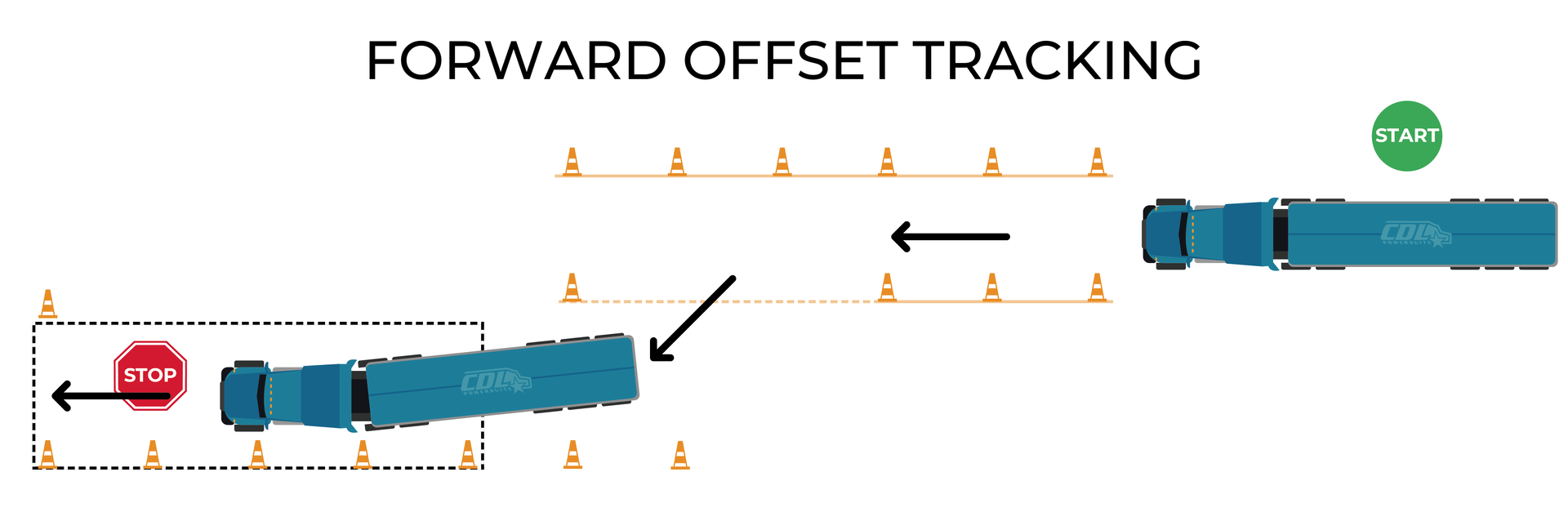

A diagram of a forward offset tracking system

Reverse Offset Backing:

Modernized Basic Control Skills Test Exercise 4

Objective:
To assess your ability to offset back and park accurately within a confined space.


  • Starting Position: Begin parallel to the outer boundary cones.

  • Executing the Maneuver: Back into the alley you pulled out of during the Forward Offset exercise:
  • You’re allowed only two get-out-and-looks to check your position.
  • You may also use two free pull-ups without penalty. Additional pull-ups will result in point deductions.
  • Ensure the rearmost part of your vehicle ends up in the stop box.

  • Completing the Maneuver: Once in position:
  • Set the parking brake
  • Shift to neutral
  • Sound your horn to signal the examiner that you’re done.
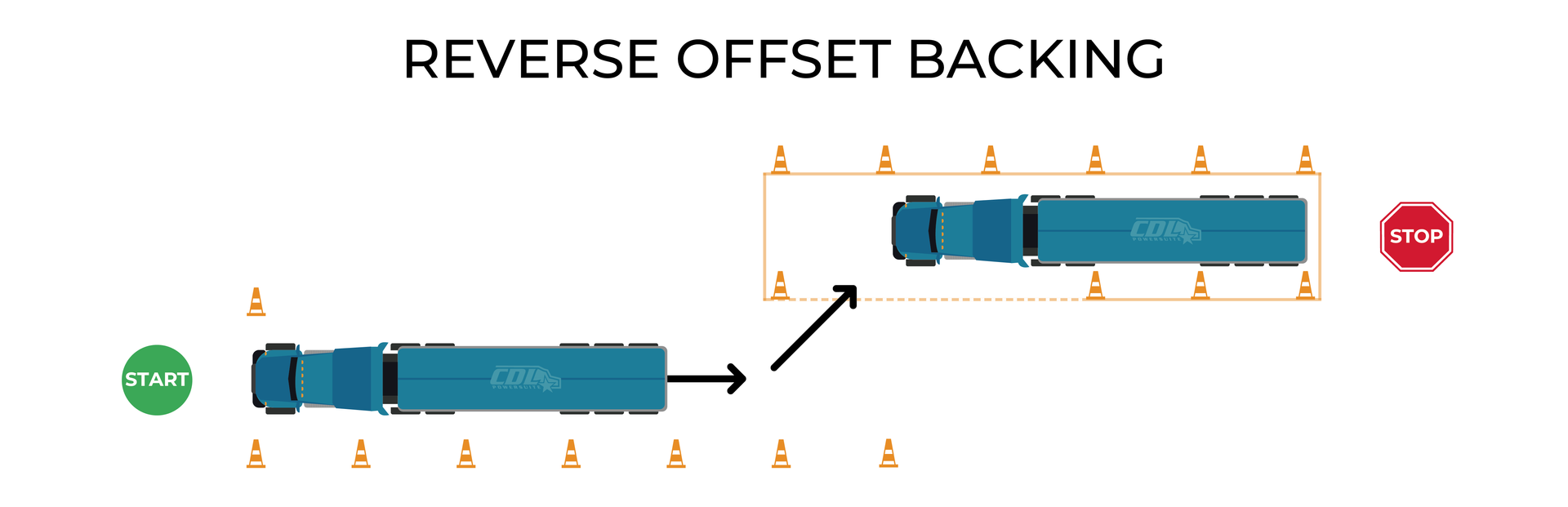

A diagram of a reverse offset backing.
September 15, 2026
2026 has certainly been an eventful year for entry-level driver training (ELDT) and enforcement across the industry. We can all agree that we support the goal of making our highways safer, and in many ways, we applaud these efforts. However, when enforcement efforts cast a wide net, some organizations will inevitably be caught up in it. Unfortunately, that is sometimes the nature of enforcement. These audits provide an opportunity to examine how training providers can identify gaps in meeting ELDT requirements. At CDL Power Suite, we have received a significant number of questions and comments from training organizations. Our goal is to share some of the audit deficiencies we have seen throughout the industry. Student self-certifications One of the more surprising deficiencies—particularly during the first round of audits—involved student self-certifications under 49 CFR § 380.725(b)(1). It is remarkable how many organizations thoroughly addressed the curriculum, theory, and behind-the-wheel requirements but overlooked this provision. The required self-certification must be completed and maintained for every student. All applicants accepted for behind-the-wheel training must have this self-certification on file. Instructor qualification files The second most frequently reported deficiency involves instructor qualification files. Training organizations that use third-party examiners already understand the importance of keeping instructor qualification files current. This is critical. If an instructor’s file is not compliant for any period of time, the organization must be able to document that the instructor did not train students during that period. Instructor qualification files are essential, and we could spend an entire day discussing them. Most organizations understand what is required; the challenge is having a system that consistently monitors those files. Many items in an instructor qualification file require advance planning. If physical examinations, renewals, or other requirements are left until the last minute, an organization can quickly find itself in a difficult position. A reliable tracking and reminder system is essential. Training all six basic skills The third issue we have heard about most often involves organizations that train only for the modernized skills test. Given the amount of news and industry discussion surrounding ELDT, it is surprising that some organizations still do not understand that all six basic skills must be taught. We have even heard individuals say, “Our state told us we did not have to do that.” Unfortunately, the state will not be standing beside you during an audit, and that explanation will not satisfy an auditor. You must know what is happening on your training range. Many of us become so focused on keeping the operation moving that we never step back to see what is actually taking place. Be aware of team members who begin teaching only what is necessary to pass the test. We track first-time and overall pass rates, but we cannot allow the pursuit of better scores to cause us to abandon our principles or training standards. Every organization should have a consistent method for defining and documenting proficiency. Train instructors properly Before addressing any of these issues, we need to emphasize the importance of properly training instructors. Too often, organizations hire and train instructors in the middle of a crisis. That approach creates unnecessary risk. These audits are likely to continue. In my more than 30 years in the industry, I have not seen anything quite like them. They resemble an accreditation audit, a third-party audit, and a state board of education review occurring at the same time. Unlike many audits in the past, auditors already have access to information about your previous graduates through your Training Provider Registry (TPR) number. Your organization’s history is already reflected in the records they review. For that reason, it is vital to understand: - What is happening on your training range - How instructors are trained - How instructors’ grade and assess students - How your organization defines proficiency - What information is being entered into the TPR - How changes and updates are communicated to your team Too often, we overlook the seriousness of the information posted to the TPR. When you make a change or post information, slow down and explain to your team why accuracy matters and how seriously that information will be treated. These audits are not a one-time event. They are becoming a way of life for the industry.
August 17, 2026
Every certification your school submits to the Training Provider Registry rests on one thing: the instructor who signed off was qualified to do it. That makes instructor qualifications the single highest-stakes file in your building. When a student's record gets questioned, the school defends one certification. When an instructor's qualifications get questioned, every student that instructor ever signed off is in question at the same time. One gap, multiplied by hundreds of graduates. That is why instructor files deserve more attention than they usually get, and why "we know our people are qualified" is a sentence worth retiring. Knowing it and proving it are two different jobs. The second one is the one that counts. What qualified actually means The federal requirements come down to a few things. A behind-the-wheel instructor needs to hold a CDL of the same or higher class, with the endorsements needed for the vehicle they are teaching in, plus at least two years of experience driving that class of vehicle or two years of experience as an instructor. A clean licensing history matters too. An instructor whose CDL has been suspended, revoked, or cancelled in the recent past can be disqualified from teaching, even if their license looks valid today. Then the states add their own layer. Some require instructor licenses, background checks, or their own experience documentation on top of the federal floor. The federal rule is the minimum, and your state decides how much higher the bar sits. A school operating in more than one state can have different qualification requirements for instructors doing the same job. Qualified on paper, provable on demand Here is where schools get caught. The instructor genuinely is qualified. Twenty years behind the wheel, endorsements for everything, sharp as they come. But the file holds a photocopy of a CDL from three renewals ago and nothing else. When someone asks the school to prove the qualification, the proof is a phone call to the instructor asking them to bring their license in. A complete instructor file answers the question before anyone asks it. A current copy of the CDL with the right class and endorsements. Documentation of the experience that qualifies them, whether that is driving history or instructional history. The MVR on file and reviewed. State instructor credentials where they apply. Every requirement, matched to a document, sitting in one place. When an auditor asks, the answer takes minutes instead of a scramble.